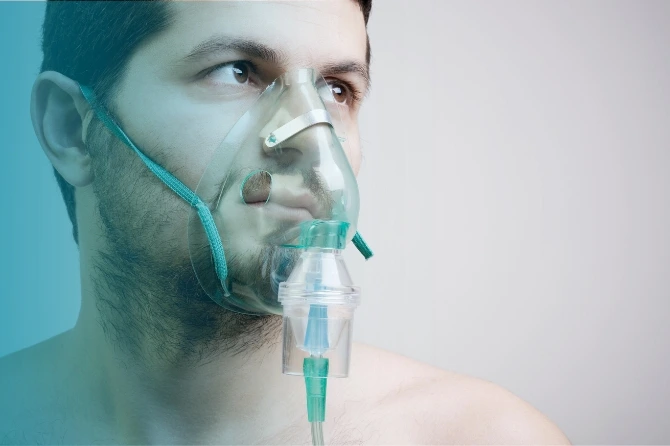
Your brain uses 20% of your oxygen. Supporting brain oxygenation means supporting your concentration, your reactivity and your stress management: discover how OxyVita accompanies you every day.
studied by universities, public institutes and a hospital [N2][N4][N5][N8]
The essentials in 20 seconds
Mental clarity that changes your days
3 pm. The meeting drags on, the emails pile up, and you are reading the same sentence for the third time. You know that “slump”. You might put it down to lack of sleep or workload. But have you ever wondered what your brain really needs to stay sharp from morning to night? The answer largely comes down to one word: oxygen. Good brain oxygenation is the foundation of a clear, productive day.
The brain uses 20% of your oxygen for only 2% of your body weight [N9].
OxyVita contains 18 to 20 mg of dissolved oxygen per litre, about twice as much as ordinary water [N8][N10].
Studies show a significant improvement in cognitive reaction time and a reduction in the stress index [N3].
Our advice: 1 to 1.5 litres a day, in a programme of 21 days, starting each morning with a large glass.
Oxygen supporting your daily life
A sharper, calmer, more efficient brain
Everyone comes here with their own question about brain oxygenation and everyday energy. Choose the area that suits you: you will find clear explanations, the related studies and our tips for making OxyVita part of your daily life.
Performance
& sport
Your muscles produce their endurance energy thanks to oxygen. Discover what researchers at Semmelweis University measured on strength and reflexes.
Your brain never rests. Even while you sleep, its tens of billions of neurons constantly exchange electrical and chemical signals. Each of these exchanges uses energy, in the form of ATP, produced in the mitochondria thanks to oxygen and glucose.
The brain stores almost no reserves: it depends, second by second, on the oxygen delivered by the blood. That is why it uses around 20% of your body’s oxygen for only 2% of your body weight [N9]. Without continuous brain oxygenation, concentration and memory quickly suffer.
All these functions rely on this continuous supply.
Hypoxia and modern life
Why do we sometimes
lack energy?
Hypoxia refers to a situation in which a tissue has less oxygen than it needs. The brain is one of the organs most sensitive to these variations. Screens, meetings, poorly ventilated rooms, stress, a sedentary lifestyle, dehydration: our modern way of life puts brain oxygenation to the test.
Screens and back-to-back meetings
Mental fatigue and reduced reactivity.
Poorly ventilated rooms and shallow breathing
Less oxygen with each breath.
Stress and a sedentary lifestyle
A higher demand for oxygen.
Insufficient sleep
A less efficient brain.
The everyday solution
Move, ventilate, sleep well and drink OxyVita: four simple habits to support brain oxygenation.
What the studies measured
Concrete results on concentration and stress
AARMS journal (2017)
Randomised, double-blind trial with 48 participants aged 50 to 75. Over 4 weeks, participants drinking oxygen-rich water significantly improved their cognitive reaction time, and their stress index decreased. The effects peaked during the third week [N3].
Semmelweis University (2007)
Two groups of ten adults reduced their reaction time by 20 to 22 milliseconds on average (right hand) during a session combining drinking and bathing in oxygen-rich water. Their stress index fell from 22.4% to 16.8% in the first group and from 23.8% to 19% in the second [N4].
Good habits
How can you support brain oxygenation every day?
Good brain oxygenation does not depend on a single action, but on a combination of simple habits. Your blood carries oxygen to your neurons: anything that supports breathing, circulation and hydration therefore contributes to brain oxygenation.
1. Breathe deeply, several times a day
In front of a screen, breathing often becomes short and shallow. Get into the habit of taking a few slow, abdominal breaths every hour: breathe in through your nose for four seconds, breathe out for six. This little ritual calms the nervous system, supports brain oxygenation and helps you regain focus.
2. Move to boost circulation
A ten-minute walk after lunch, a few flights of stairs, some stretches between two meetings: physical activity speeds up blood circulation and supports brain oxygenation. No need to aim for performance; regularity matters more.
3. Air your living and working spaces
In a closed office, the air quickly fills with CO₂ and alertness drops. Open the windows for at least ten minutes, morning and afternoon, to renew the air you breathe.
4. Sleep well to recover
Sleep is when the brain sorts things out and regenerates. Regular hours, a cool bedroom and a break from screens before bed are your best allies.
5. Drink enough, and choose an oxygen-rich water
Even slight dehydration is enough to reduce attention. Drink regularly throughout the day. With its 18 to 20 mg/L of dissolved oxygen, OxyVita fits naturally into this routine: a simple habit to support brain oxygenation, with no additives and no hassle [N8][N10].
Bonus: take breaks away from screens
Roughly every 90 minutes, give yourself a real break: stand up, look into the distance, take a few steps, drink a glass of water. These micro-breaks release built-up tension, boost circulation and allow your attention to recharge before the next task.
Key takeaways
Your brain is a demanding organ that works non-stop. To stay focused, creative and calm throughout the day, it needs a regular supply of oxygen, water and rest. The right habits for brain oxygenation are simple: breathe deeply, move every day, air your spaces, sleep enough and stay well hydrated.
By adding OxyVita to this routine, you add an easy, pleasant habit to your daily life without disrupting your routine. Try the 21-day programme and see the difference for yourself in your energy, mental clarity and stress management.
Frequently asked questions about brain oxygenation
What are the signs of poor brain oxygenation?
Mid-day fatigue, difficulty concentrating, frequent yawning, headaches or a feeling of “brain fog” may indicate a lack of air, movement or sleep. If these symptoms are persistent or intense, consult a healthcare professional.
How much oxygen does the brain use?
Around 20% of the body’s oxygen, even though it accounts for only 2% of body weight [N9]. It stores almost no energy: brain oxygenation must therefore be continuous.
How do I make OxyVita part of my routine?
Simply drink OxyVita as your usual water, preferably in small sips throughout the day. To find out more, discover our page dedicated to OxyVita water.
Does oxygen-rich water help brain oxygenation?
The studies presented above observed an improvement in cognitive reaction time and a reduction in the stress index in people drinking oxygen-rich water [N3][N4]. Combined with good breathing, physical activity and quality sleep, OxyVita is a simple ally to support brain oxygenation every day.
Does OxyVita replace medical treatment?
No. OxyVita is a drinking water that complements a balanced lifestyle. It is not a substitute for medical advice or treatment.
Discover OxyVita
What if you regained your mental clarity?
Start your 21-day programme, then compare with how you felt before. An exceptional water to support brain oxygenation and enjoy sharper, calmer days.
To provide the best experiences, we use technologies such as cookies to store and/or access device information. Consenting to these technologies will allow us to process data such as browsing behavior or unique IDs on this site. Not consenting or withdrawing consent may negatively affect certain features and functions.
Functionnal
Always active
Technical access or storage is strictly necessary for the legitimate purpose of enabling the use of a specific service explicitly requested by the subscriber or user, or solely for the purpose of transmitting a communication over an electronic communications network.
Preferences
Technical access or storage is necessary for the legitimate purpose of storing preferences that are not requested by the subscriber or user.
Statistics
Technical storage or access that is used exclusively for statistical purposes.Technical storage or access that is used exclusively for anonymous statistical purposes. In the absence of a subpoena, voluntary compliance from your Internet Service Provider, or additional records from a third party, the information stored or retrieved for this sole purpose generally cannot be used to identify you.
Marketing
Technical access or storage is necessary to create user profiles for sending advertising, or to track the user on a website or across multiple websites for similar marketing purposes.