 Watch the testimonial
“
Arthur Serrières
One of the greatest champions in the history of cross triathlon
- 🏆5-time World Champion
- 🏆6-time European Champion
- 🏆36 World Cup wins on the XTERRA circuit
OxyVita
Oxygen and sport are inseparable. Endurance, strength, recovery, reflexes: discover how OxyVita can help you push your limits naturally.
A slightly alkaline water, with no additives
[N14]
only after 5 days with the bottle open
[N14]
The essentials in 20 seconds
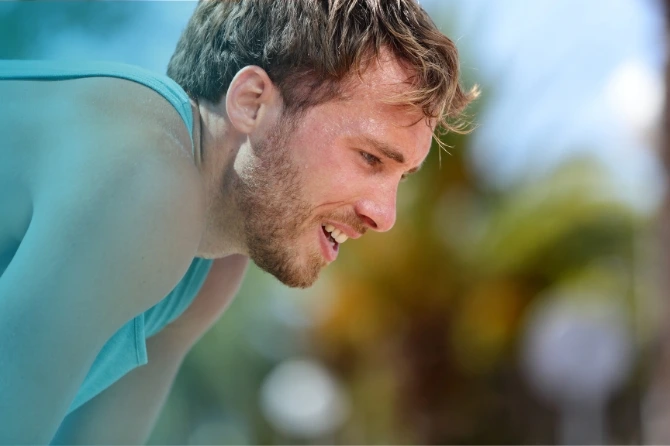
Every muscle contraction uses ATP, the molecule that serves as “fuel” for your cells. Your muscles only store a few seconds’ worth: they must therefore produce it continuously. Three energy systems take turns. The first two, fast but limited, work without oxygen and run out quickly: this is the explosiveness of the sprint, and the burning sensation linked to the build-up of metabolic waste.
The third, the aerobic system, takes place in the mitochondria. It uses oxygen to produce very large quantities of ATP over a long period: that is why oxygen and sport are so closely linked.
Energy
(sprint)
(limited capacity)
(endurance)

VO2max is the maximum amount of oxygen your body can use per minute during intense exercise. It is expressed in millilitres of oxygen per kilo of body weight per minute. It is one of the best indicators of your endurance capacity, at the heart of the relationship between oxygen and sport.
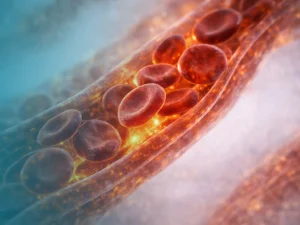
It relies on a complete chain: the lungs take in oxygen, the heart pumps it, the blood carries it and the muscles use it. Training improves each of these links. Your hydration is also part of this chain, as water makes up most of the blood plasma that carries oxygen to the muscles. Managing the oxygen-and-sport duo well therefore also means looking after your hydration (see also: OxyVita and muscle fatigue).
The effort does not stop when you cross the finish line. After the session, your breathing remains rapid: your body continues to use more oxygen to replenish its energy reserves, eliminate the waste produced during exercise and start repairing muscle fibres. It is during this phase that you really progress: in recovery too, oxygen and sport go hand in hand.

Two groups of ten adults saw their reaction time shorten by 20 to 22 ms, their grip strength increase and their oxygen saturation improve after a session combining drinking and bathing in oxygen-rich water. The stress index fell in both groups [N4].
In the animal part of this study published in PLOS ONE, rats drank stably oxygen-enriched water for seven days. The partial pressure of oxygen in arterial blood reached 335 mmHg, compared with 188 mmHg with tap water [N2].
Top-level athletes share their experience.
Watch the testimonial
One of the greatest champions in the history of cross triathlon
 Watch the testimonial
French Master +50 e-cycling Champion 2025 (French Cycling Federation)
Discover OxyVita
Oxygen and sport: start your 21-day programme and discover the difference in your training and recovery.